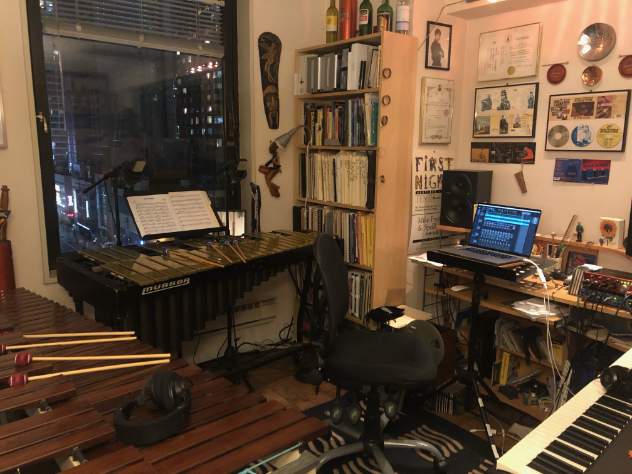
Recording:
Vibraphone, Marimba, and light percussion tracks.
Recorded here into Pro Tools at up to 192khz 24 bit and delivered to you over the internet.
Producing
Composing, Arranging
Private Teaching: Vibraphone, Improvisation, Composition, Theory
———————————————————————————
Additional Services:
Audio: ProTools Editing, Mixing, Mastering and light recording, CD/DVD - Burning and Transfers
Video: Editing
Graphic Design: Flyers, Brochures, Pamphlets, Newsletters
Writing: Flyers, Brochures, Pamphlets, Newsletters
Photo: Photography, Editing, Touch up
Web Site: Design and Building
Mac Help: computer lessons, setups, upgrades, trouble shooting etc.
info at jazzvibe.com
mike at jazzvibe.com
anne at jazzvibe.com
Mike Freeman / Anne Haas
917-680-0026, 212-736-3961
———————————————————————————
Software
Pro Tools & Logic Pro
Sonnox, Waves, Avid and other plugins
Finale & Dorico notation software
FinalCut Pro
Gear
Focusrite Clarrett 4 Pre interface
2 Art Tube MP pre-amps
Mackie HR624 monitors
Parasound Hint 6 amp
B&W Diamond 805s speakers
JL Audio E110 sub woofer
Fostex SW 1.1 speakers
Mics
2 AKG 414 XLS
2 AT-3035 mics
1 SM57 mic
Vintage Audio:
Kurzweill PC88 keyboard
Nachamichi LX-3 cassette deck
Sony A6 DAT machine
Setton RS 660 receiver (sold)
Yamaha RX-777 receiver (sold)
Audio Analyst M8 speakers (sold)
Audio Analyst AX100 speakers (sold)
Event TR8s monitors (sold)
Tascam DA-38’s digital recorder (2 sold)
Roland SC-88 sound module (recycled)
MacPro G5 Tower (sold)
MacPro Towers 2009 (2-sold)
Digi Rack 002 interface (sold)
The vibraphone is a descendant of the African xylophone, of the marimba found in Guatemala and Mexico, and of instruments of the gamelan orchestra found in Bali and Java. It was invented in the United States toward the beginning of the 1900's and was popularized by jazz musicians Lionel Hampton (with clarinetist Benny Goodman) and Milt Jackson of the Modern Jazz Quartet. Some other notable vibraphonists are Gary Burton (who popularized the use of playing with four mallets), Cal Tjader (known for playing Latin music), and Bobby Hutcherson.
The bars of the instrument are struck by mallets of varying hardnesses. The vibraphone looks similar to a xylophone and a marimba. The difference is that the bars of both the xylophone and marimba are made of wood. In general terms, the xylophone is a soprano or high register marimba (the difference being in the tuning and timbre). The bars of a vibraphone are made of metal. The vibraphone also has a sustain pedal like a piano that when depressed allows the notes to ring until the pedal is lifted again. The vibraphone originally got its name because it has a motor that turns metal discs, called pulsators, located under the bars at the openings of the resonators or tubes. The rotation of the pulsators gives a "vibrato" (more accurately tremolo) sound to the instrument. Without this motor the vibraphone could just as easily be called a metalophone because of it's metal bars.
Mike Freeman
Vibraphone Special Effects:
Bending notes on the vibraphone
Developed by Gary Burton in the early 70’s
Audio examples: (being reformatted for this 2926 website update)
1. Vibe Bend
2. Vibe Bend2
3. Vibe Bend Music
4. Vibe Wah Wah
Harmonics created by dampening the center of a bar while striking the nodal point. Most audible on lower notes of the instrument.
Bowing the vibraphone:
Done by bowing the end of a bar, similar in effect to rubbing your finger on the edge of a wine glass.
Mouth and hand vibrato (tremolo)
Done by opening and closing your mouth directly over a ringing bar or pulsating your hand up and down over a ringing bar.
Marimba Special Effects:
The use of special mallets such as mallets rapped in cellophane.
Sign up for our email list, it's used sparingly! Mike Freeman Mail List
Connect with Mike Freeman Social Media